book review · The Gods Themselves
The Gods Themselves
2026-04-29 · 3 min read
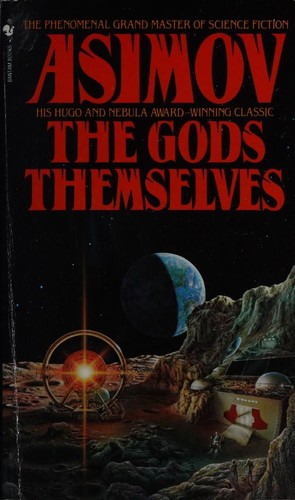
This is structured as three almost-standalone parts, Earth, a parallel universe, and the Moon, connected by one physics idea, an energy exchange between our universe and one with different fundamental constants that seems too good to be true because it is. I’ve read most of the Robot and Foundation books, and this is a genuinely different kind of Asimov, weirder, less interested in tidy plot mechanics and more interested in following an idea until it gets uncomfortable.
The middle section is the reason this book is remembered, and I’d go further than most reviewers and say it’s the reason to pick this book up at all. Told entirely from the point of view of an alien species with a three-sexed reproductive and family structure, it’s some of the strangest, most genuinely alien worldbuilding I’ve come across in a novel this old, Asimov building an entire culture, biology, and family unit that doesn’t map onto human categories at any point, and doing it with real emotional stakes instead of treating the alienness as a gimmick. A few readers have wished he’d written more in that mode instead of just the one section, and I feel that same pull, it’s a shame this remains a one-off rather than the start of something.
Where the book struggles is the bookend sections, particularly the third part on the Moon, which several reviewers rightly flag as a step down, a story that leans on a lucky coincidence to wrap things up rather than earning its resolution the way the alien section does. The first section, setting up the political fight over the energy exchange on Earth, works fine as scaffolding but is the most conventionally Asimov part of the book, competent, a little dry, carrying real hard-science weight about the physics of the exchange without ever quite catching fire the way the middle does. Read as a whole it’s an uneven but genuinely ambitious book, three different registers of science fiction stapled together by one idea, and even the weaker thirds are worth sitting through to get to the part that isn’t weak at all.